
Embark on Your Personal Performance Improvement Journey.
Here’s a FREE 7-Step Course Designed For Your Success as a Major Gift Officer.
Its “Secret Sauce” is the Key Success Factors.
This highly interactive, live online course will take you on a performance improvement journey.
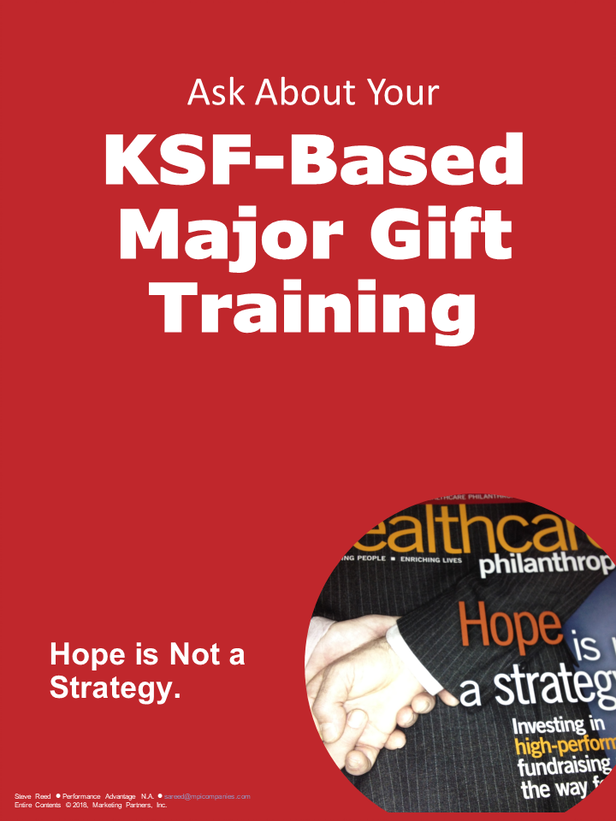
This course is based on the training and coaching major gift officers experience in fundraising organizations making the transition to the Fundraising Performance Imperatives system. The only difference is it is designed to enhance individual success in any major gift fundraising program.
This course is free—a one-time offer only for working gift officers who sign-up for this cohort—because this is the first time this material has been offered outside of a client organization.
The course introduces the Core Process, a structured way to identify potential individual donors of significance before engaging with them in an exploration of ways the organization can be important to the donor’s own philanthropic objectives. It is based on the Fundraising Performance Imperatives as guides for a systemic approach to developing highly productive, mutually beneficial donor relationships.
Defy Conventional Thinking
You’ll learn why the Fundraising Performance Imperatives sometimes defy conventional fundraising thinking. One example: “It takes 18 months to secure a major gift.” This is a self-fulfilling prophecy. What stretches out the timeline for major gifts? Simply the traditional way we work.
Conventional wisdom is a development professional should have 100-150 prospects and previous donors in his or her file—which probably includes several prospects who are not ready to move forward and many of whom are poorly qualified. It’s a wonder that anything moves forward. It’s a little like a laptop with too many programs open at once. The bottom-line result is often poorly planned and largely ineffective use of valuable time. And the donor experiences a lack of intensity and a fragmented series of “business meetings” rather than a deepening relationship and a dialogue.
Introducing the Key Strategies
The Fundraising Performance Imperatives come from Lean Six Sigma thinking and borrow from other forms of advanced management theory, performance improvement, the quality movement and social psychology. But to find your path to success, all you must learn are only three essential strategies: Focus on Philanthropy, Connect with Donor Priorities and Build Lifelong Relationships.
Focus on Philanthropy
The formal first definition of Philanthropy from Merriam-Webster is “goodwill to fellow members of the human race,” which is then amplified as “active effort to promote human welfare.” It is important to understand that philanthropy and fundraising are not synonymous. An imperative is to avoid transactional fundraising—other than as a way of initiating potentially philanthropic relationships.
The Core Process restructures the fundraising effort to enable a strategy focused on philanthropic giving. It is a continuum from pipeline development through stewardship through repeat giving. It focuses your time on donors who have the capacity to give significant gifts.
Connect with Donor Priorities
Traditional fundraising is, in Lean terminology, “push” based. It’s about raising “X” amount of money for “Y” purpose. But Penelope Burk—today’s premier researcher into donor perceptions—reports a shift in donor expectations. More and more donors are thinking like philanthropic investors. They are no longer as willing to simply support institutions as in the past.
Despite that, there’s more talk about “donor-centricity” today than actual evidence of it in practice. One reason may be the absence of a widely used model or “track” for frontline fundraisers to facilitate a more donor-oriented approach. Staff-based major gift fundraising programs grew out of intense capital campaign strategies to enlist the maximum number of donors in support of a very specific goal. Classic capital campaigns were “push” programs to sell the case for support, unlike modern marketing “pull” strategies more concerned about having what people want to buy.
The Core Process offers a structured means to identify potential individual donors of significance and then engage with them in an exploration of ways your organization can be important in the potential donor’s own philanthropic objectives. The primary job of the development professional is to “connect the dots.” This is a subtle, yet radical departure from current practice.
Build Life-long Relationships
Industry data show a very poor donor retention track record. Many organizations lose three out of four donors within a relatively short period of time. Research by Penelope Burk provides evidence of donor dissatisfaction with many organization’s behavior once a gift is secured.
The core imperative is to prioritize the donor relationship. Every aspect of your strategy should be oriented to create a life-long relationship with the donor. The Core Process—while appearing linear on paper—is truly a circle. The strategy is to look to the next gift while advancing towards the immediate gift. The donor must not see a lessening in the relationship once the gift is secured. The Core Process provides “track” that continues to deepen the donor’s relationship with you and paves the way toward continuing giving.
The beneficial consequence of this is like that of compounding interest. Over time, your portfolio of significant repeat donors grows at the same time as new donor relationships are being established. The result is a larger average gift and an overall level of philanthropic performance that far exceeds that achieved through more traditional approaches.
The essence of the Core Process is grounded as much in the best of classic fundraising theory as in Lean Six Sigma and other performance improvement thinking. But the Fundraising Performance Imperatives system gives you a solid foundation for putting theory into practice.
Ask for more information and to reserve your place.
Email us at jrechtien@mpicompanies.com or fill out the form below and we will be in touch.